Read Time:
3 minutes
Articles

Something unusual just happened in the digital signage industry. One of its largest players was dismantled, assets sold off, subsidiaries wound down, clients left to figure out what comes next. It's a scenario most operators never plan for, because most never thought it could happen to a company of that size.
It can. And it just did.
The lesson isn't about any one company. It's structural. When your entire signage operation — hardware, CMS, player, device management — is tied to a single vendor, you haven't built a signage network. You've rented access to one. And when that vendor hits trouble, your network hits trouble with it.
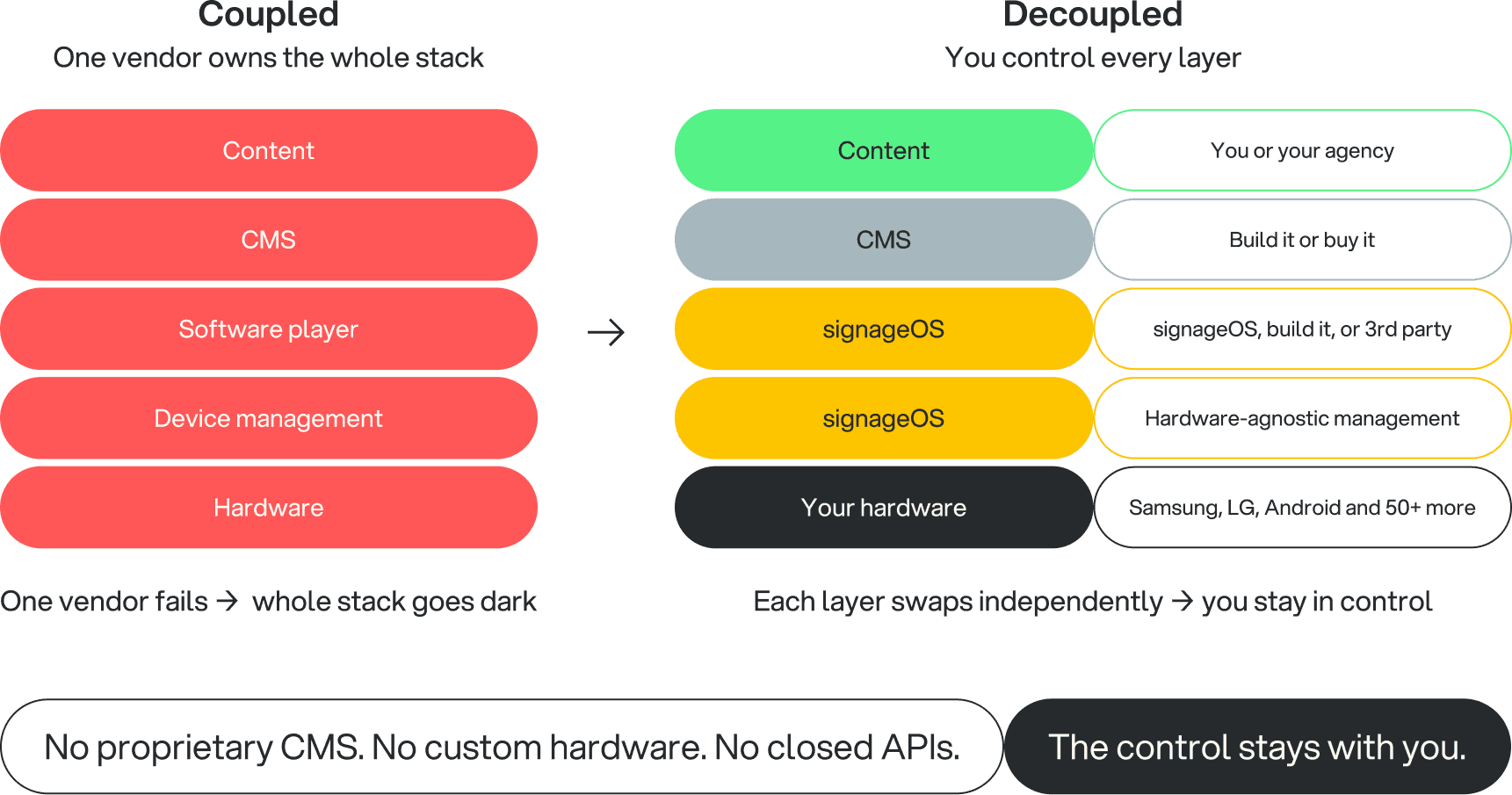
One vendor fails, and the whole stack goes with it
The digital signage industry has historically run on bundled platforms: one vendor for hardware, CMS, player and device management. It works on a small scale. But as networks grow, that simplicity becomes a liability. Roadmap decisions aren't yours. Hardware procurement isn't yours. When you need to move fast or when a vendor disappears, you realize how little of your most important marketing channel you actually own.
The deeper problem is architectural. When every layer of your stack sits on a single vendor's survival, a failure at any one point brings everything down with it. Decoupling changes that. When each layer can change independently, a CMS that stumbles gets swapped out while the rest of the network keeps running. And when a hardware line gets discontinued, your existing devices keep working while any new hardware you add is automatically compatible.
It's also worth noting: signageOS is a layer in that stack too. But a standardized, API-driven foundation behaves differently than a proprietary bundle. It's interoperable by design, doesn't tie your hardware or software to a single vendor, and is built so your network keeps running regardless of what changes around it.
Operators who have been through this kind of disruption don't rebuild the same way. They build differently.
We've documented what purpose-built signage management looks like in practice, including a checklist for evaluating any platform you're considering.
A different model is already working at extraordinary scale
One of the world's largest digital signage deployments made this shift. With tens of thousands of screens across North America and an intentionally mixed hardware fleet, they achieved a 99.99%+ uptime standard while supporting millions of customer interactions every day.
They didn't find a better CMS. They built their own, and used signageOS as the infrastructure layer that made it possible.
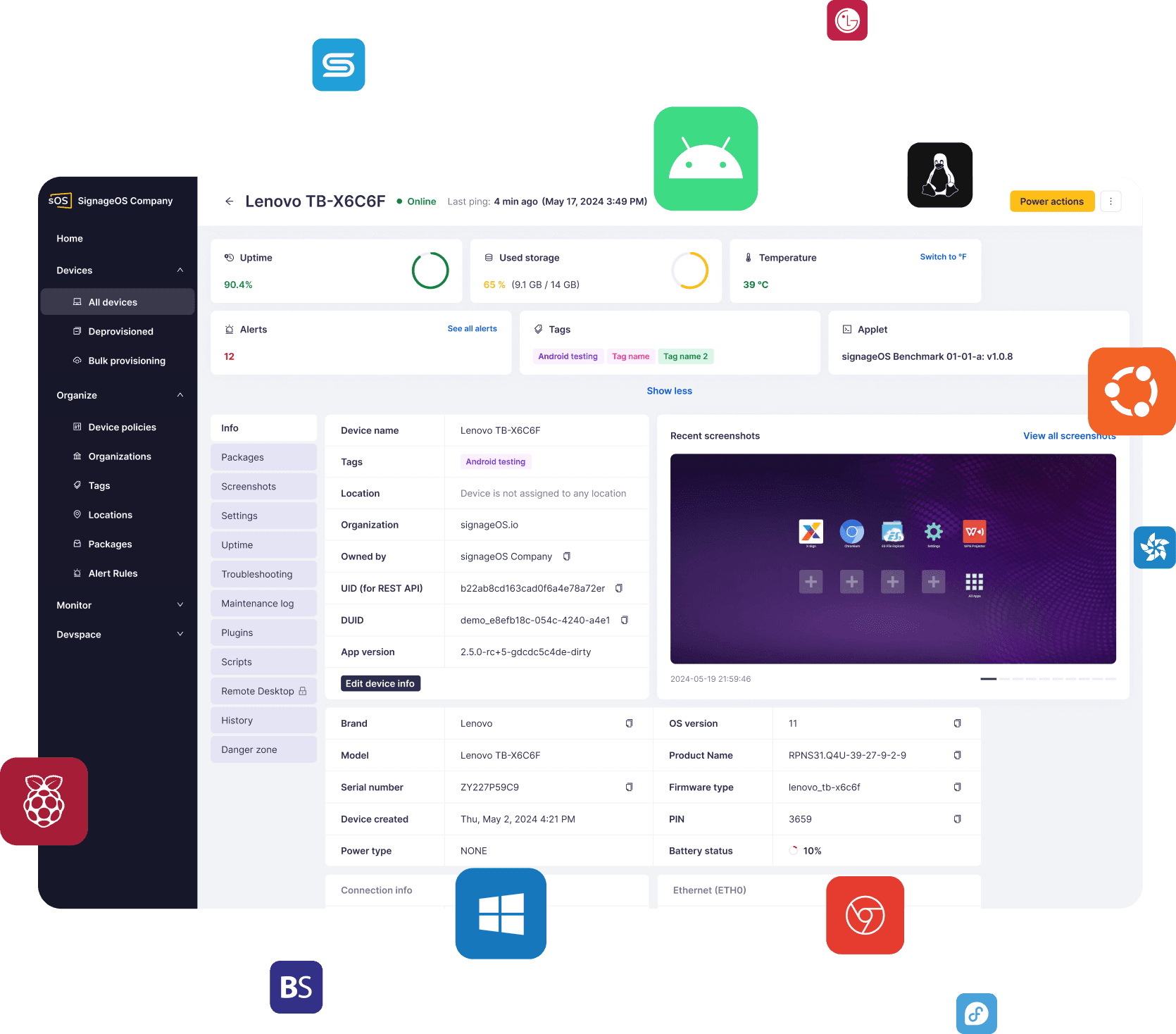
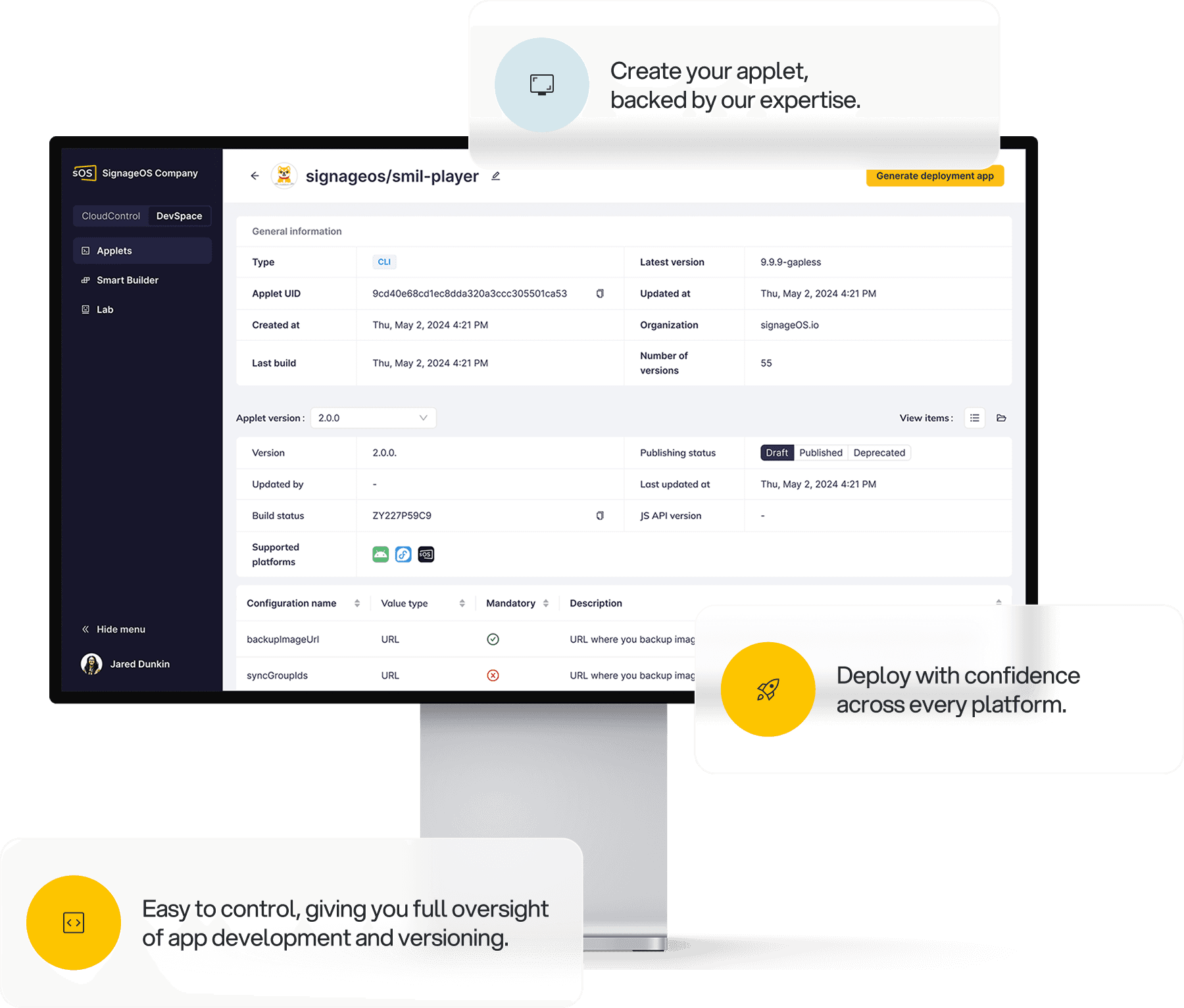
DevSpace turned their proprietary CMS into a native client across 50+ hardware platforms, eliminating the fragmentation that comes with mixed fleets. CloudControl connected every device through a single REST API, providing real-time visibility, remote troubleshooting, automated alerts, all without on-site intervention. The result: a vendor-agnostic procurement model that restored genuine competition between suppliers for the first time.
If you're evaluating your current management setup, this video is worth watching.
You don't have to start from scratch
You don't have to rebuild from scratch — signageOS fits with what you already have. Already running Samsung or LG displays? Compatible. BrightSign? Compatible. Android, Linux, Windows? All supported. signageOS sits between your hardware and your software as a neutral, stable runtime that doesn't care what's above or below it.
The infrastructure layer that stays stable when everything else shifts
Vendor consolidation, company closures, and hardware cycles aren't anomalies. They're the ongoing reality of the signage industry. The organizations that navigate them best aren't the ones who found the right vendor. They're the ones who stopped depending on any single one. That's what next-gen signage is built for.
signageOS gives you the building blocks: DevSpace for hardware compatibility, CloudControl for operational command, and a hardware-agnostic layer that lets you build, convert, or extend your network on your timeline, not a vendor's.
The future belongs to flexible networks.
Don't wait for a vendor failure to find out how resilient your network is. Talk to our team today.
FAQ
What is single-vendor dependency in digital signage and why is it a risk?
Single-vendor dependency means your hardware, CMS, player, and device management are all tied to one provider's survival. When that vendor hits financial trouble, gets acquired, or winds down operations, every layer of your network is affected simultaneously — content delivery stops, device management disappears, and recovery requires emergency action. The digital signage industry has seen this play out at scale in 2026, leaving operators with thousands of healthy screens and no way to control them.
What happens to my digital signage network when a major vendor collapses?
When a vendor collapses, operators on coupled stacks lose control of their entire network overnight — not just one layer. Content delivery stops, device management disappears, and recovery typically requires emergency hardware procurement, costly migrations, and truck rolls across thousands of locations. Operators running decoupled architectures with a hardware-agnostic infrastructure layer like signageOS can swap the affected layer remotely while the rest of the network keeps running.
How do I make my digital signage network resilient against industry disruption?
The most resilient signage networks are built so no single vendor decision can take everything down. This means decoupling each layer — hardware, CMS, player, and device management — so each one can change independently. signageOS sits between your hardware and your software as a neutral, stable runtime across 50+ platforms, ensuring your network keeps running regardless of what changes in the vendor landscape around it.
What does a vendor-agnostic digital signage infrastructure look like in practice?
A vendor-agnostic infrastructure uses a standardized middleware layer — like signageOS — between hardware and software. This means hardware is chosen on merit and cost rather than CMS compatibility. The CMS can be swapped without touching devices, and any new hardware added to the fleet is automatically compatible.
Can I switch my digital signage CMS without replacing my hardware fleet?
Yes — if your infrastructure layer is decoupled from your CMS. With signageOS in place as the middleware layer, switching CMS platforms means pointing a new solution at the same fleet through a single API integration. No hardware write-off, no truck rolls, no multi-year migration program. This approach has been proven at extraordinary scale: operators running tens of thousands of devices have made platform transitions remotely, preserving their entire hardware investment in the process.