Read Time:
6 mins
Blogs

Why brands deploying digital signage should own the standard, not rent it from their vendors
Lukas Danek, co-founder and Chief Product Officer of signageOS, is watching operators make infrastructure decisions under pressure that will shape their networks for years, and he decided the current moment was worth writing about.
By Lukas Danek, CPO of signageOS
If you run screens at scale, somewhere in a flagship store, across a thousand QSR locations, or in every branch of your network, ask yourself one question: if your current software provider disappeared tomorrow, what would happen to those screens?
For most brands, the honest answer is uncomfortable. The screens would keep glowing, but you would have lost control of them. The content management system, the player application, often the hardware itself, all of it was chosen and wired together by a provider. The integration logic lives in their codebase. The device fleet speaks their protocol. Replacing them does not mean signing with someone new. It means re-engineering the network, often re-buying parts of it, and doing both under time pressure while your screens degrade in public.
This is not a hypothetical. It is the default architecture of digital signage today. And it quietly transfers control of an asset you paid for to vendors you merely contracted.
The asset and the software age at different speeds
A commercial display or media player is a capital expenditure with a five to ten year life. The software ecosystem around it is nowhere near that stable. In the last decade alone, every major platform your network might run on went through at least one disruptive transition.
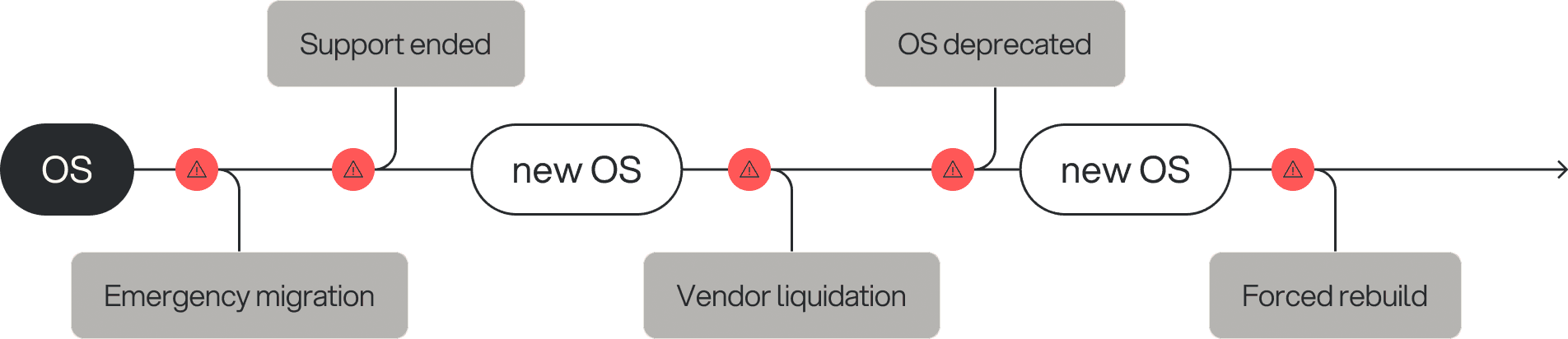
Samsung's signage displays moved through three distinct platform eras, from the original SSSP generations to Tizen and most recently to TEP, a new enterprise platform that required software vendors to rebuild their applications against new APIs. LG made its own generational jump from NetCast to webOS, with the device APIs continuing to shift between firmware generations since. Google's ChromeOS, once a darling of signage deployments, deprecated the entire Chrome App model those deployments were built on: support ended in early 2025, and the app runtime is being removed from kiosk mode entirely through 2026, while ChromeOS itself migrates onto a new Android-based foundation. And on the PC side, Windows 10 reached end of support in October 2025 with countless signage networks still running on it, because the hardware was bought to last far longer than the operating system did.
Every platform transition costs the operator. Every time.
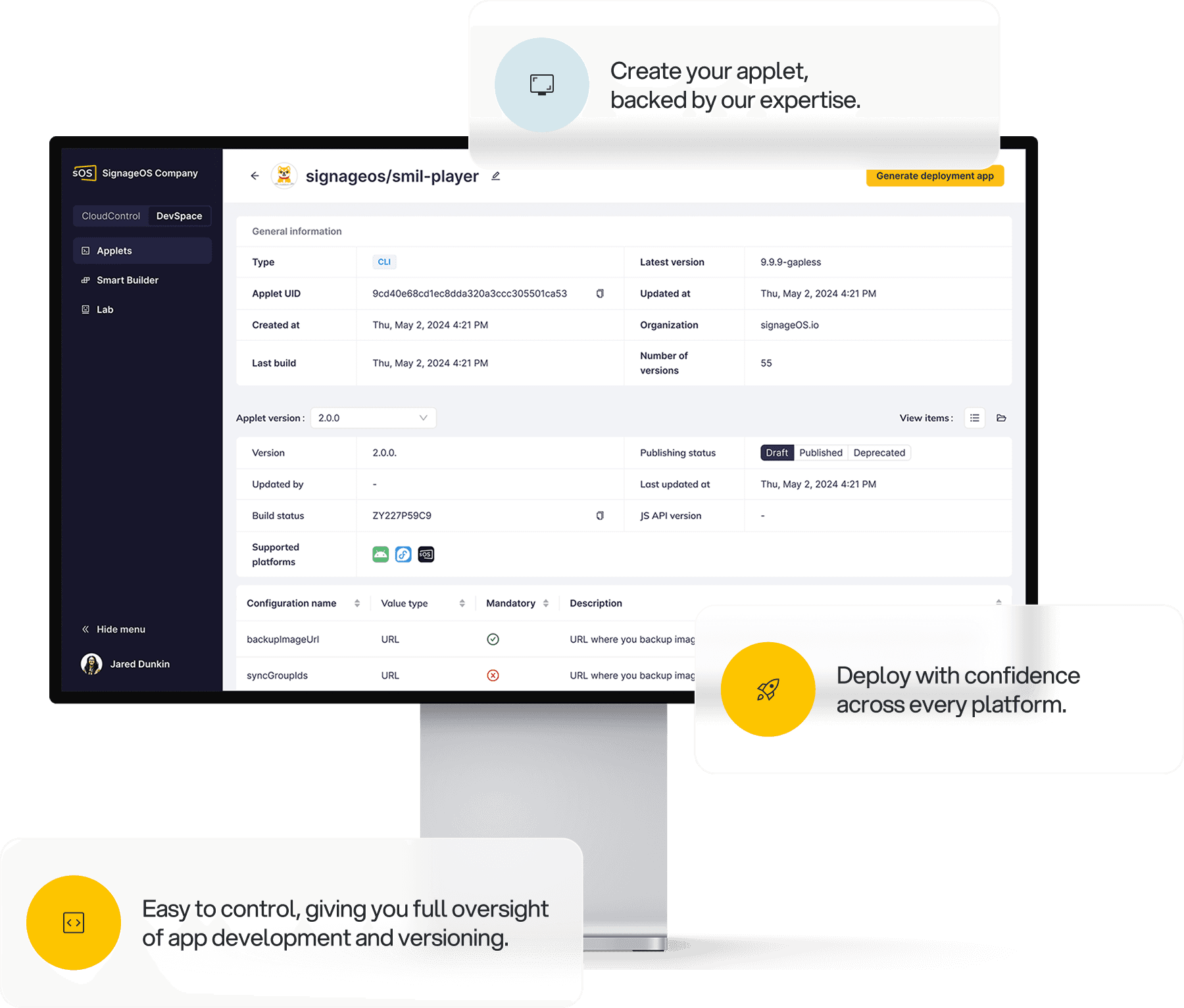
signageOS applications built in 2018 are still running today. Zero code changes.

None of these vendors did anything wrong. Platforms evolve for good reasons. But notice who absorbed the cost every single time: not the platform vendor, and not the software provider either, at least not ultimately. The brand did. In delayed rollouts, forced hardware refreshes, emergency migrations and screens that stopped doing what they were bought to do.
Your screens will outlive the platforms they run on. The only question is whether your network is designed for that fact.
The scenario every operations leader should run
Picture a large QSR brand. Thousands of locations, drive-thru menu boards, in-store promotion screens, maybe a growing retail media business selling those screens to beverage and CPG partners. The whole estate runs on a solution built by one provider, on that provider's custom hardware players.
Now the provider drops the ball. Maybe they get acquired and the product is sunset. Maybe their roadmap stalls and the features the retail media team needs never arrive. Maybe quality slips, support response times stretch, and franchisees start escalating. The reason barely matters. What matters is the brand's position the day it decides to move.
With a conventional architecture, that position is terrible. The player hardware is proprietary, so it cannot run anyone else's software. The new provider's software needs new devices, so the capex spent on the old fleet is written off years early. Swapping hardware in thousands of locations means truck rolls, ladder time, store disruption and a migration program measured in quarters, sometimes years. The incumbent knows all of this, which is exactly why the relationship deteriorated in the first place. When switching costs are that high, your vendor's incentive to earn your business every year quietly evaporates.
Now run the same scenario with signageOS in place as the standardization layer. The brand's devices, whatever mix of SoC displays and players it owns, run on our unified APIs, which any compatible solution can plug into. The day the provider drops the ball, the brand selects a new CMS or builds its own, points it at the same fleet, and migrates remotely. No truck rolls. No hardware write-off. No multi-year program. The screens never notice the divorce.
That is the difference between renting your network's foundation and owning it.
Standardize the layer, keep the flexibility
The instinct of many enterprise IT and procurement teams is to solve this by standardizing on a single hardware vendor or a single end-to-end provider. That reduces complexity on paper and increases dependency in reality. You have simply chosen whose roadmap and pricing you will inherit.
The better move is to standardize one level down: not on a vendor, but on the API layer between your devices and whatever software runs them. When that layer is stable and vendor-neutral, everything above and below it becomes swappable.
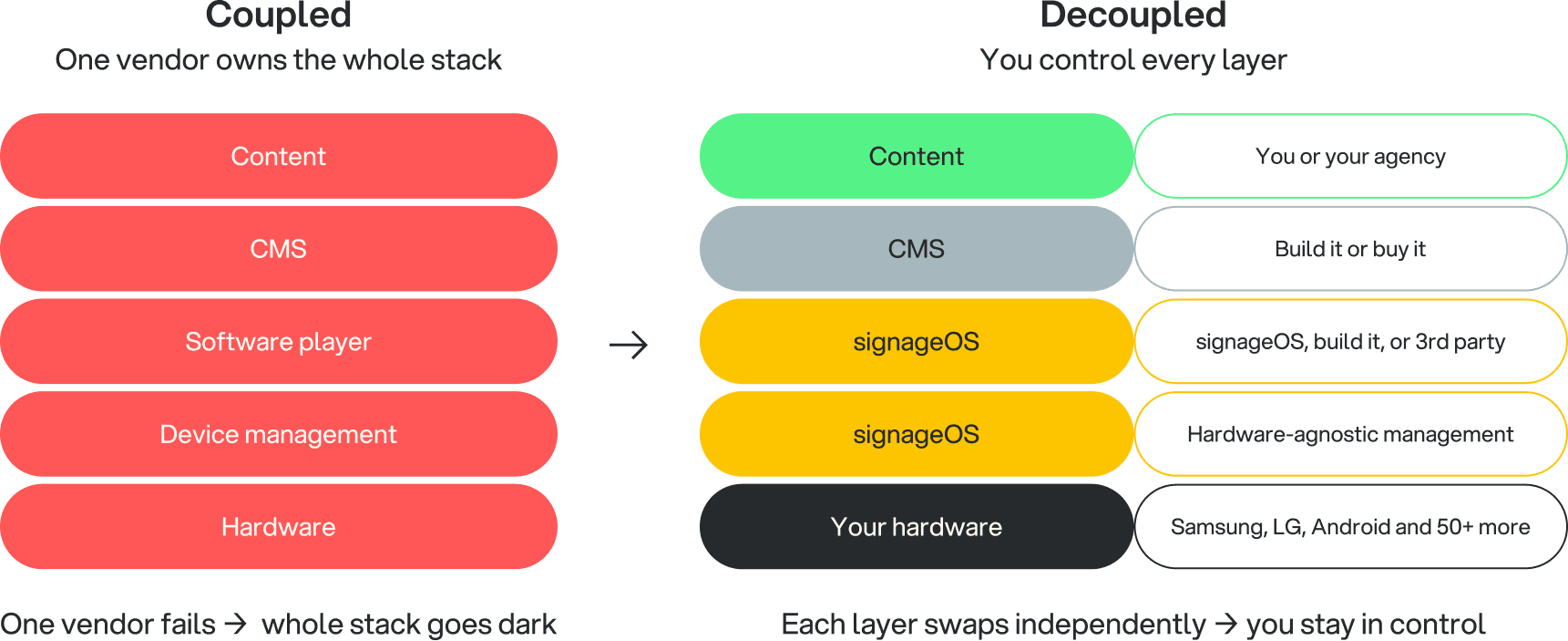
Hardware becomes a procurement decision again. You buy displays and players on price, availability, spec and regional support, not on software compatibility. You can mix Samsung in one market, LG in another, Android or Linux players where they make sense, and run it all as one network. When a vendor's pricing drifts or a supply chain tightens, you substitute. Your suppliers know you can, which changes every negotiation.
Capex is protected. Devices serve their full depreciation life regardless of what happens in the software layer above them. Solution changes stop forcing hardware changes.
Migration becomes remote and gradual. Moving to a new solution, or running two in parallel during a transition, happens over the network, store by store, on your schedule. Pilots stop being expensive. So does changing your mind.
You design the future platform instead of inheriting one. Brands increasingly want their screen network to be infrastructure: a foundation for retail media, dynamic pricing, AI-driven content, in-store analytics. Infrastructure needs a stable contract underneath it. With one in place, you can evolve the experience layer continuously for a decade without ever touching the foundation.
"Stability is not a feature of the product. It is the product."

Why your IT stack can't do this
A fair question from any CIO: we already have device management, MDM, endpoint tooling. Why is this not just an IT problem with an existing IT answer?
Because digital signage is not a generic endpoint. The estate is full of hardware that no horizontal IT tool was built for: System-on-Chip displays from Samsung, LG, Sony, Philips and others where the "computer" is the panel itself, each with its own OS, its own provisioning flow, its own firmware regime. Purpose-built players. Outdoor and high-brightness units. Video walls with synchronization requirements. LED controllers. The operational needs are equally specific: frame-accurate playback, power scheduling, automatic failover when content sources fail, proof-of-play for media buyers, remote firmware management across a dozen incompatible platforms, screens that must recover on their own at 6 a.m. in a store with no IT staff.
An MDM can tell you a device is online. It cannot tell you the screen is actually rendering the right content, at the right brightness, in sync with the panel next to it, and it certainly cannot move your player application from a Tizen display to a webOS display unchanged. This is why the standard layer for signage had to be built specifically for signage. That is what signageOS is. We have spent the last ten years building exactly this standard, across more than 40 device platforms, absorbing every vendor transition listed above so that the networks running on top of us did not have to. Applications built on signageOS unified APIs in 2018 are running in production today without a single code change, through every platform upheaval since. The standard did not exist, so we built it, and a decade of unbroken compatibility is the proof that it holds. That stability is not a feature of the product. It is the product.
The control test
Here is a simple test for any brand evaluating its signage architecture, current or future. Ask your team three questions.
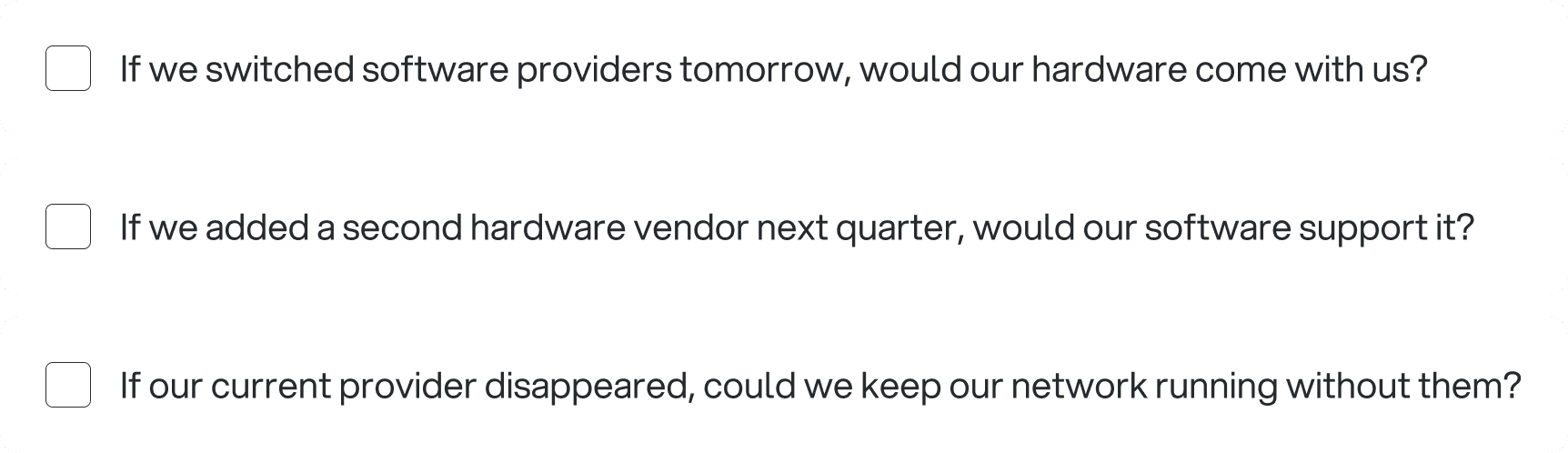
And if the answer to any question is no, who is actually in control of this network?
Screens are becoming one of the most valuable surfaces a physical brand owns. Retail media alone is turning them into revenue infrastructure. An asset that strategic should not be one vendor failure away from a crisis, and it does not have to be. The standard exists. It has held for ten years through every platform disruption the market produced, and it keeps the thing every operator ultimately wants: the freedom to choose, change and grow on your own terms, for the full life of the hardware you paid for.
Your network. Your devices. Your decisions. That is what a standard is for.
Ask your team the three questions. If you don't like the answers, we should talk.
FAQ
What happens to my digital signage network if my vendor shuts down?
If your stack is tied to a single vendor, a shutdown means losing control of your screens immediately. Content delivery stops and recovery requires emergency migration or hardware replacement. Networks built on a hardware-agnostic infrastructure layer are designed so the CMS can be swapped remotely while screens keep running.
How do I migrate my digital signage network without replacing all my hardware?
In most cases you don't need to replace hardware at all. signageOS onboards existing devices remotely — including SoC displays, proprietary Linux players, and mixed fleets — without on-site re-enrollment or truck rolls.
Can I replace my digital signage CMS without replacing my screens?
Yes . If your infrastructure layer is decoupled from your CMS. With signageOS in place, swapping a CMS means pointing a new solution at the same fleet through a single API, saving operators millions in hardware costs.
Why doesn't my MDM work for digital signage?
MDMs can confirm a device is online but cannot verify what's on screen, manage SoC displays like Samsung Tizen or LG webOS, or recover screens automatically in unstaffed locations. Digital signage requires a purpose-built management layer.
How do I future-proof my digital signage network against platform changes?
Standardize on the API layer between your devices and your software, not on any single vendor's platform. With a hardware-agnostic infrastructure layer in place, new hardware is automatically compatible and software can be swapped without touching a single device.