Articles

Your screens are the most visible thing your organization runs. Hundreds or thousands of public-facing endpoints, mounted in lobbies, storefronts, branches, and drive-thrus, displaying your brand to everyone who walks past. A compromised laptop is an internal incident. A compromised screen is a headline, photographed and shared before your team even sees the alert.
That visibility is the entire point of digital signage. It's also why signage security can never be an afterthought. In next-gen signage, security isn't a feature you evaluate on a comparison chart. It's infrastructure, built into the architecture from the start.
Why signage security is different from IT security
Most enterprise security thinking is built around private failure. A breached server, a leaked database, a phished inbox. Serious, expensive, but contained: your security team manages the incident and controls the story.
Digital signage inverts that model. The failure mode is public by design. If unapproved content reaches a screen, your customers see it before you do. If screens go blank across a region, every person walking past knows something is wrong. The screen doesn't just carry the risk. It broadcasts it.
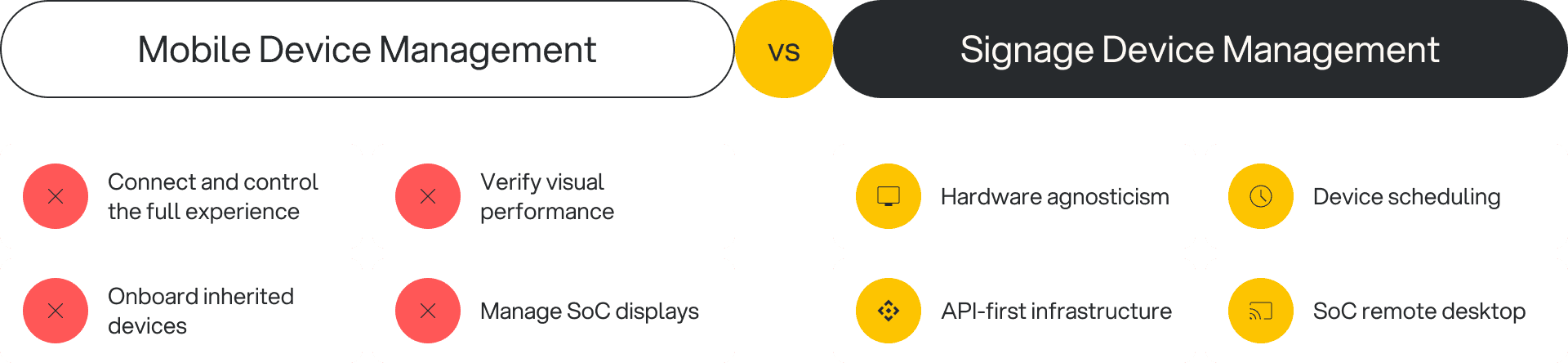
Signage networks also live in conditions most IT assets never face. Devices sit in physically accessible public spaces. They run on varied hardware across dozens, sometimes hundreds, of locations. They stay in the field for years. Generic MDM tools treat a screen like any other endpoint. It isn't one.
Your vendor's security is your security
Here's the uncomfortable structural truth: when you run digital signage, you inherit the security posture of every layer in your stack. The device firmware, the operating system, the player, the platform that manages it all. Whatever their standards are, those are now your standards.
This is not a criticism of any vendor. Most take security seriously. The problem is structural: an inherited posture is not a verified posture. Your security team cannot audit what it cannot see, and your procurement team cannot assess what a vendor doesn't independently prove.
So the real security question when evaluating signage infrastructure isn't "does this vendor say they're secure?" Every vendor says that. The question is: what independent evidence does each layer of your stack give you?

Why SOC 2 Type II and ISO 27001 matter for signage networks
signageOS is SOC 2 Type II and ISO 27001 certified, and both certifications cover the platform as a whole.
These are worth unpacking, because they answer different questions.
SOC 2 Type II
SOC 2 Type II verifies that security controls don't just exist on paper, but operate effectively over an extended audit period. A Type I report is a snapshot. Type II is filmed over months of real operation. For an organization trusting a platform with thousands of public-facing endpoints, that difference matters.
ISO 27001
ISO 27001 certifies an information security management system: a systematic, continuously maintained approach to identifying, managing, and reducing security risk across the organization. It tells you security is an operating discipline, not a one-time project.
“For enterprise customers, SOC 2 Type II is not simply a nice-to-have, it's the entry ticket. If you want to run infrastructure inside an enterprise network, you have it, or you're not in the conversation."

Certifications protect the infrastructure. What about the screen?
There's a gap most security conversations miss. Your infrastructure can be fully certified and operating perfectly while the layer your customers actually see fails. A screen showing the wrong content, stale content, or nothing at all is a business failure no infrastructure audit will catch.
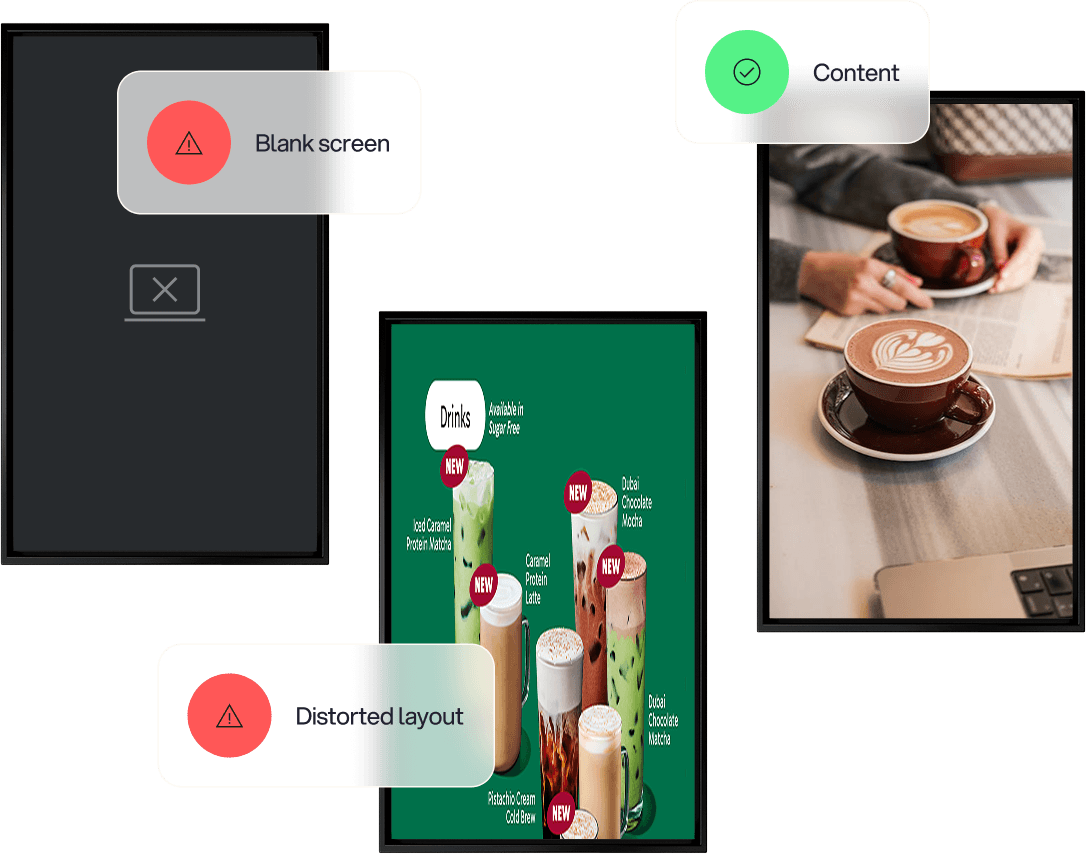
That's the problem Content Guard AI exists to solve. Extending CloudControl, it continuously analyzes what is actually displayed on your screens across the entire fleet — not what was scheduled, not what was sent, but what's really there. Blank screens, system menus, broken layouts, missing applets, and malicious content are flagged in real time, before a customer photographs them.
The AI layer goes beyond visual matching. Teams define what should (and shouldn't) appear on screen in natural language, and the system interprets whether the visible content makes sense in context. Because it's hardware-agnostic, it works across devices, operating systems, and CMS platforms without changing your existing setup.
Think of it as closing the loop: the certifications verify the platform is secure, and Content Guard AI verifies the outcome is correct. That's the difference between "our vendor is compliant" and "we know what every screen in the network is showing right now."
Content Guard AI
Validates content and triggers alerts to keep every device performing as expected.
Security as a layer you own
Next-gen signage means building your network from interchangeable layers you control, and security is one of those layers. In a single-vendor stack, your security posture is whatever comes bundled. You didn't choose it, and you can't change it without changing everything.
In a stack you own, security becomes a deliberate choice. You select an infrastructure layer with independently verified credentials. You add continuous on-screen validation because your brand demands it. And when your requirements evolve, you upgrade the layer, not the entire network.
Your screens face the public. Your security shouldn't face the unknown.
Bring your security team to the conversation.
FAQ
Can digital signage screens be hacked?
Any connected device can be targeted, and digital signage carries added exposure because devices sit in public spaces and failures are visible to everyone. The practical defenses are infrastructure with independently audited security controls, encrypted device communication, and continuous monitoring of what screens actually display.
What is SOC 2 Type II, and why does it matter for digital signage?
SOC 2 Type II is an independent audit verifying that a company's security controls operated effectively over an extended period, not just at a single point in time. For digital signage, it means the platform managing your public-facing screens has proven its security practices in operation, not just in documentation.
What does ISO 27001 certification mean for a signage vendor?
ISO 27001 certifies that a vendor runs a formal information security management system: a structured, continuously maintained process for identifying and reducing security risks. It signals that security is embedded in how the company operates rather than handled ad hoc.
How can I monitor what my screens are actually displaying?
Traditional monitoring confirms devices are online and content was delivered, but not what's visibly on screen. Content Guard AI by signageOS analyzes actual screen output across the fleet in real time, flagging blank screens, incorrect content, and unapproved material automatically.
What security questions should I ask a digital signage vendor?
Ask for independent evidence rather than assurances: current SOC 2 Type II and ISO 27001 certifications, how device communication is secured, how quickly compromised or failing devices are detected, and whether the platform can verify what's actually displayed on screen, not just what was scheduled.