Product Updates

Greetings,
This issue's product updates, at a glance:
ServiceNow integration: an alert rule can open a ServiceNow incident automatically
Cisco Vision players: fully supported in CloudControl, managed just like BrightSign
Real-time alert events: alerts export the moment they fire, via webhook or Azure Event Hub
Tizen and webOS resilience: runners and plugins keep running through network drops
Box UI refresh: more consistent components across device management screens
For more updates on the latest features, please check our Changelogs.

ServiceNow integration: automated incident management
signageOS now integrates with ServiceNow: set up an Event Stream Distributor webhook and a ServiceNow incident opens automatically the moment an alert rule fires on a device.
Deliveries are cryptographically signed (HMAC-SHA256), so your endpoint can verify every event before acting on it, and each event carries a stable ID. The sample receiver script in the guide verifies the signature, skips repeat deliveries, and files the incident with the alert rule, an anonymized device identifier and the event details.
Why it matters: For enterprise teams already running ServiceNow as their ITSM backbone, this closes the loop between a display going wrong and a ticket landing with the right team. No manual ticket creation: our existing ServiceNow workflows, escalation rules and SLAs kick in the moment a device issue is detected.
Event Stream Distributor is an add-on that needs to be enabled on your organization, and your ServiceNow endpoint must be reachable without an Authorization header. Interested but don’t have Event Stream Distributor yet? Talk to your account manager and we’ll get you set up.
Cisco Vision players: fully supported, no extra setup
Cisco Vision digital media players are now fully supported in signageOS CloudControl. Because Cisco Vision DMPs are built on BrightSign hardware, signageOS manages them exactly like BrightSign devices, with the same provisioning, remote management, and monitoring you already use.
What this means for you:
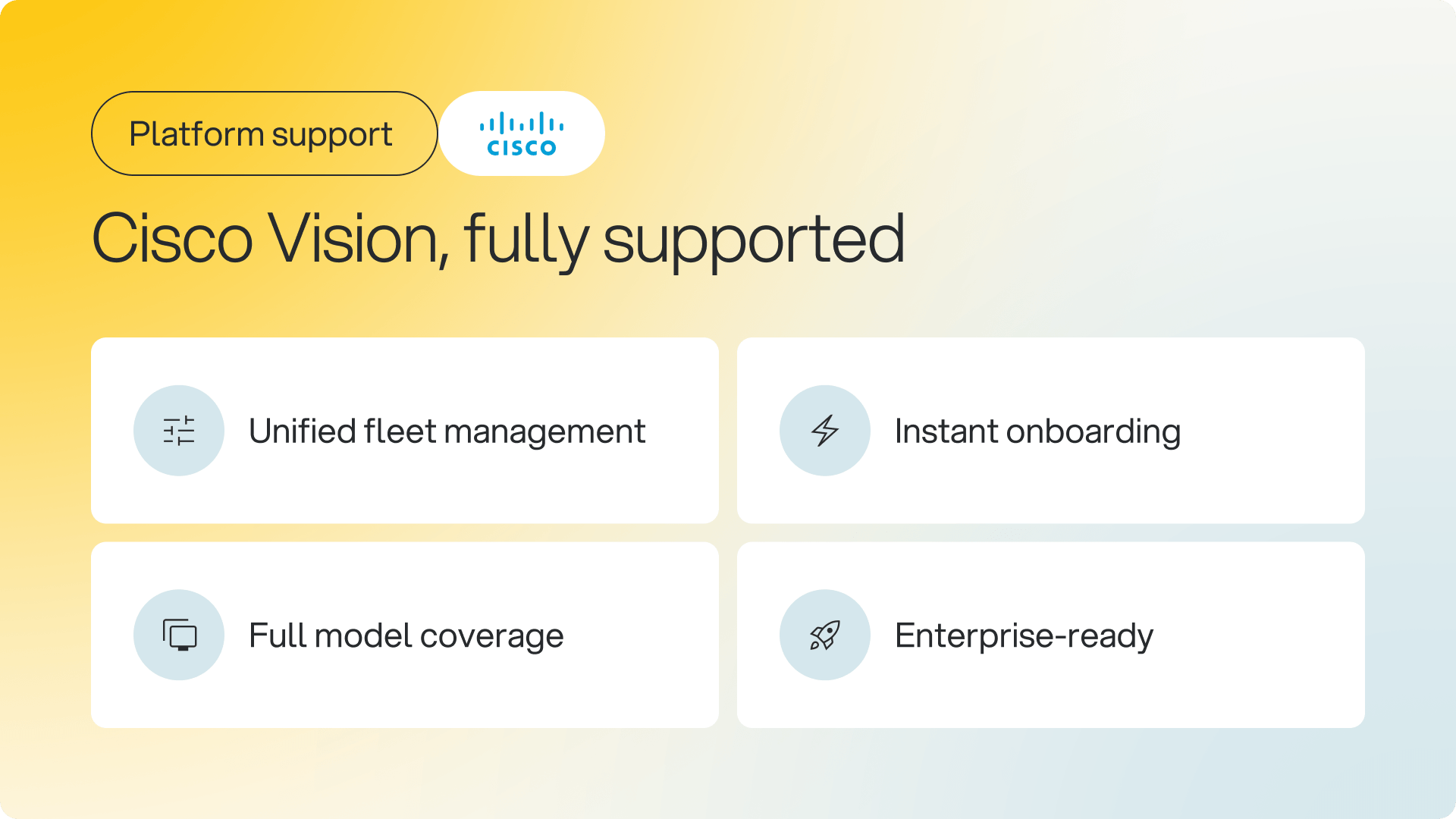
Unified fleet management: monitor and control Cisco Vision and BrightSign devices from one place, with no separate tools or configs.
Instant onboarding: if you can provision a BrightSign, you can provision a Cisco Vision player. Same steps, same experience.
Full model coverage: CV-UHD2 and CV-HD2 (Series 4) and CV-UHD and CV-HD (Series 3), with Supervisor packages available for CV-UHD2, CV-HD2 and CV-HD.
Enterprise-ready: the same proven firmware and platform stability behind thousands of BrightSign deployments.
Why it matters: Cisco Vision players are widely deployed in retail, corporate, and hospitality environments, but managing them alongside a BrightSign fleet used to mean separate workflows. Now they slot into the same signageOS workflow, so you can expand or standardize a mixed fleet without extra friction.
Availability: rolling out over the coming week.
Event Stream Distributor: alerts now flow in real time
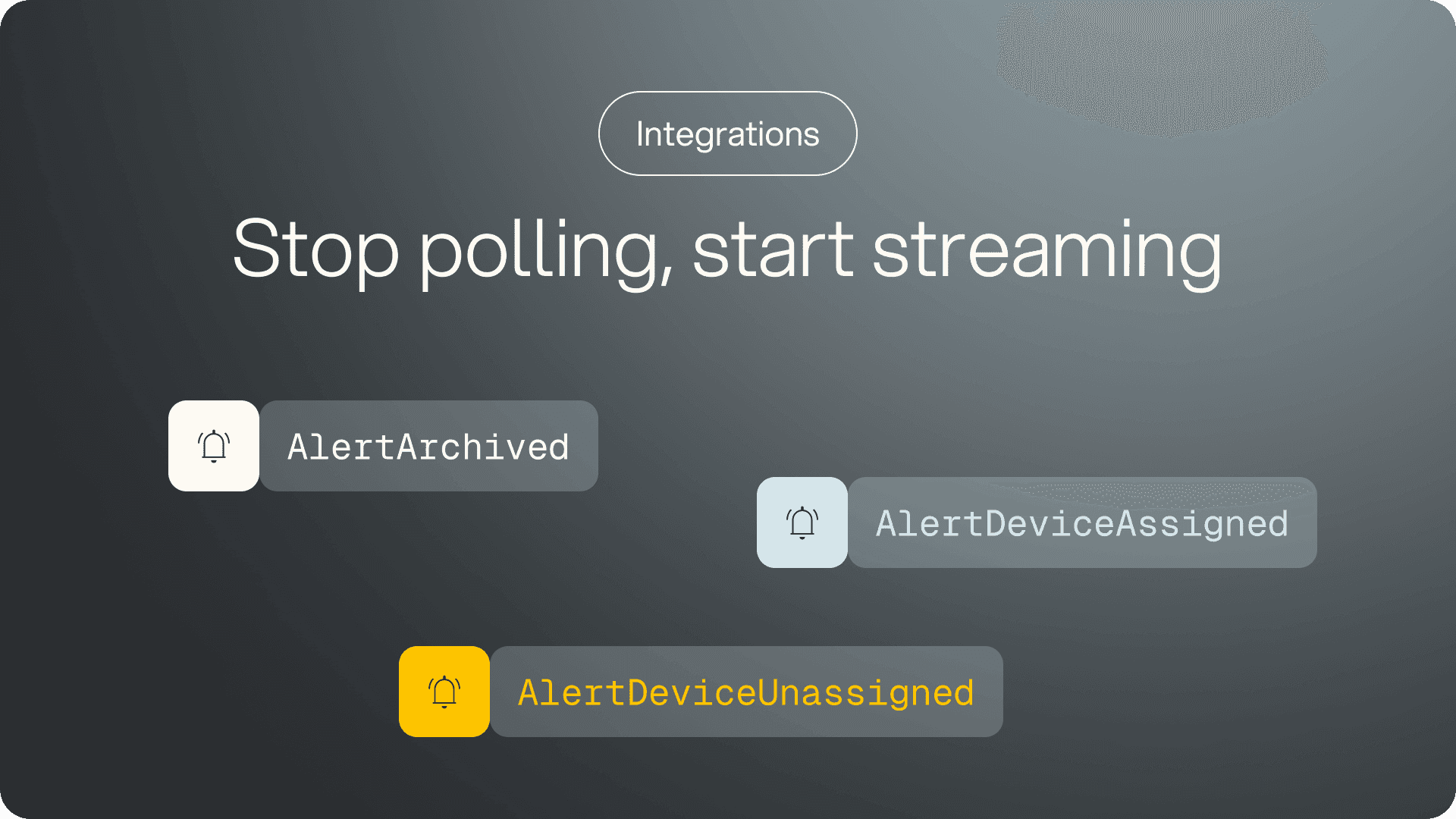
Alert events (AlertDeviceAssigned, AlertDeviceUnassigned, AlertArchived) are now first-class exportable events in the Event Stream Distributor (ESD), so your alert rules can trigger real-time actions in external systems the moment they fire, instead of minutes later through API polling. ESD's connectivity is expanding too: Azure Event Hub support is live, and generic AMQP support is on the way, so you can pipe signageOS events into whatever message broker you already run.
Why it matters: If you're building automated incident response, monitoring dashboards, or ITSM workflows, you no longer need to poll our API. Events arrive in real time, with at-least-once delivery for domain events, and you choose the transport: webhook, Azure Event Hub, or (soon) AMQP.
Tizen and webOS: better offline resilience
We've shipped patch releases for Tizen (2.12.1) and webOS (2.11.2) that fix how Plugins and Runners start on a device with no network. The device now keeps its last known configuration and starts its assigned runners immediately at boot, instead of waiting until it can reach the platform first. If you run Plugins or Runners on Samsung or LG displays, this makes your fleet noticeably more resilient in unreliable network conditions.
Why it matters: Devices in stores, venues, and other real-world sites rarely have perfect connectivity. Starting runners and plugins without waiting for the cloud means fewer gaps in what your screens are doing, and less manual recovery afterward.
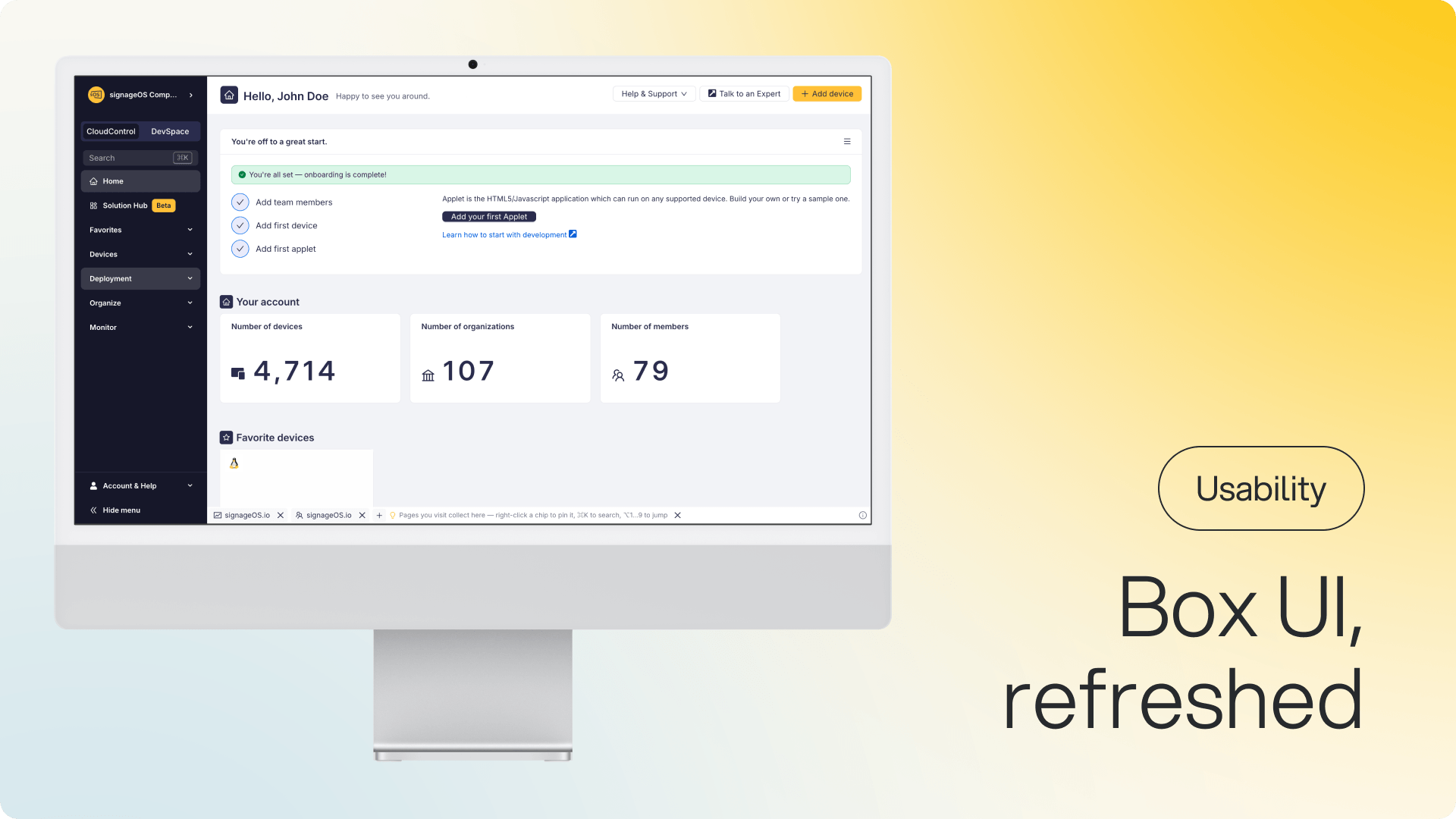
Box UI: a visual refresh and standardized components
We're standardizing Box's visual components and preparing the groundwork for a broader UI upgrade. This release brings more consistent design patterns across device management screens, a modernized component library, and smoother interactions throughout the platform.
Why it matters: A more consistent interface means faster navigation, fewer surprises, and a better experience whether you're managing 10 devices or 10,000. It also sets the stage for larger UI improvements coming next, aimed at making Box faster and easier to use.
⚠️ IMPORTANT NOTICE ⚠️
New regional network endpoints and requirements
New regional device gateways are being rolled out to improve the platform's performance, reliability, and scalability.
All devices will now connect through these regional gateways. If you haven't already updated your network and firewall configuration to allow the required regional endpoints, please do so as soon as possible to avoid connectivity issues.
If you have any questions or need help preparing your environment, contact the signageOS Support team.